
Salutations Taerniennes et Taerniens !
Dans le DevBlog de Broken Ranks du mois d’août, nous revenons sur un sujet qui empêche bon nombre d’entre vous de dormir depuis déjà un certain temps : les changements apportés aux compétences défensives. Pour certaines il suffisait d’ajuster les valeurs, mais dans plusieurs cas, nous avons décidé d’aller beaucoup plus loin et de modifier leur fonctionnement voire de leur donner de toutes nouvelles applications.
La deuxième partie de cet article sera consacrée à l’économie. Depuis quelque temps, nous observons une croissance de plus en plus rapide de la quantité d’or en circulation. Bien entendu, le fait que les joueurs s’enrichissent n’est pas un problème en soi. Le problème commence lorsque la quantité d’or générée augmente plus vite que les possibilités de le dépenser. À long terme, cela entraîne une dévaluation de l’or et une hausse des prix, en particulier pour les biens dont l’offre est limitée.
C’est pourquoi nous préparons un premier ensemble de changements économiques. Certains réduiront l’afflux d’or, tandis que d’autres augmenteront la quantité d’or retirée de l’économie. Nous souhaitons également en profiter pour améliorer plusieurs mécaniques liées à ce sujet, notamment la pénalité de mort au niveau 140.
Mais faisons les choses une par une.
Compétences défensives : où en sommes-nous ?
Le sujet des compétences défensives n’est pas nouveau. Plus tôt dans le processus, nous avons mené une enquête interne auprès d’un groupe de joueurs parmi les plus investis et expérimentés. Nous avons demandé à des représentants de chaque classe d’évaluer les compétences défensives, d’identifier leurs principaux problèmes et de signaler celles qui, en pratique, sont rarement améliorées ou ne remplissent tout simplement pas le rôle qui leur était destiné.
Nous avons combiné ces retours avec nos propres observations et les données relatives aux constructions des personnages. Sur cette base, nous avons réparti les compétences en deux groupes : celles dont le principal problème réside dans leurs valeurs et celles dont les problèmes sont plus profonds et nécessitent des modifications des mécaniques.
La conception de ces changements est désormais suffisamment avancée pour que nous puissions vous présenter la direction que nous souhaitons tester.
Gardez simplement une chose à l’esprit : les solutions décrites ci-dessous seront d’abord confiées à notre équipe de test Ad-Hoc. En fonction de leurs tests et de leurs conclusions, certaines des idées ou valeurs présentées ici pourront encore évoluer. Nous signalerons clairement ces éventuels ajustements avant l’ouverture du serveur PTR.
Druide
Le druide reçoit la plus grande plage de changements. D’un côté nous voulons améliorer ces outils de soins de base, de l’autre, nous voulons donner à « Résistance naturelle » une plus grande importance stratégique.
Guérison et Guérison de groupe
Pour Guérison, nous prévoyons de :
- réduire le coût en mana ;
- réduire l’altération « Réduction des soins » de 2 cumuls à 1 ;
- augmenter la puissance des soins de base.
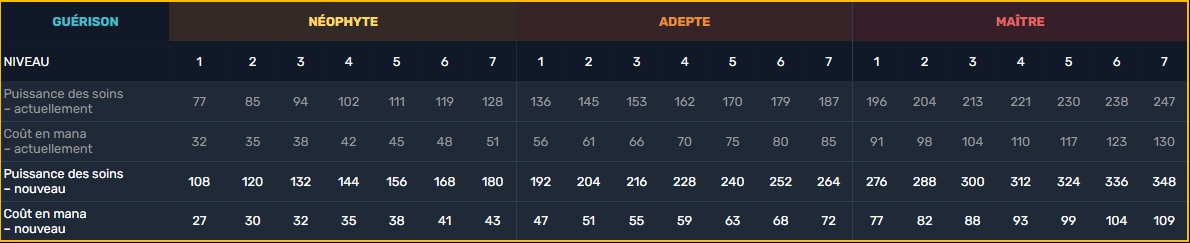
Dans le même temps, nous réduirons la puissance des soins de « Guérison de groupe ».
Nous voulons établir une distinction plus nette entre les utilisations de ces deux compétences. La Guérison à cible unique devrait restaurer davantage de PV à un seul personnage, tandis que la Guérison de groupe restaurera davantage de santé au total, mais répartie entre plusieurs membres du groupe, ce qui la rendra moins efficace pour soigner un joueur en particulier.

Résistance naturelle
Ce changement est bien plus important.
« Résistance naturelle » pourra être utilisée aussi bien sur le Druide que sur les autres membres du groupe. Un personnage affecté conservera le bonus aux résistances physiques et bénéficiera en plus d’une défense accrue au corps-à-corps, à distance, et psychique. Dans le même temps, nous augmenterons la difficulté de dissipation de l’effet à 400 points, ce qui signifie qu’il faudra davantage de Dissipations pour le supprimer.
Si le Druide utilise « Résistance naturelle » sur lui-même, il infligera également davantage de dégâts avec « Cogne ». Cela aura toutefois un prix : tant que le renforcement sera actif, la puissance de ses soins sera réduite et l’efficacité de « Dissipation » sera limitée. « Résistance naturelle » sera donc encore plus difficile à supprimer en raison de sa difficulté de dissipation accrue.
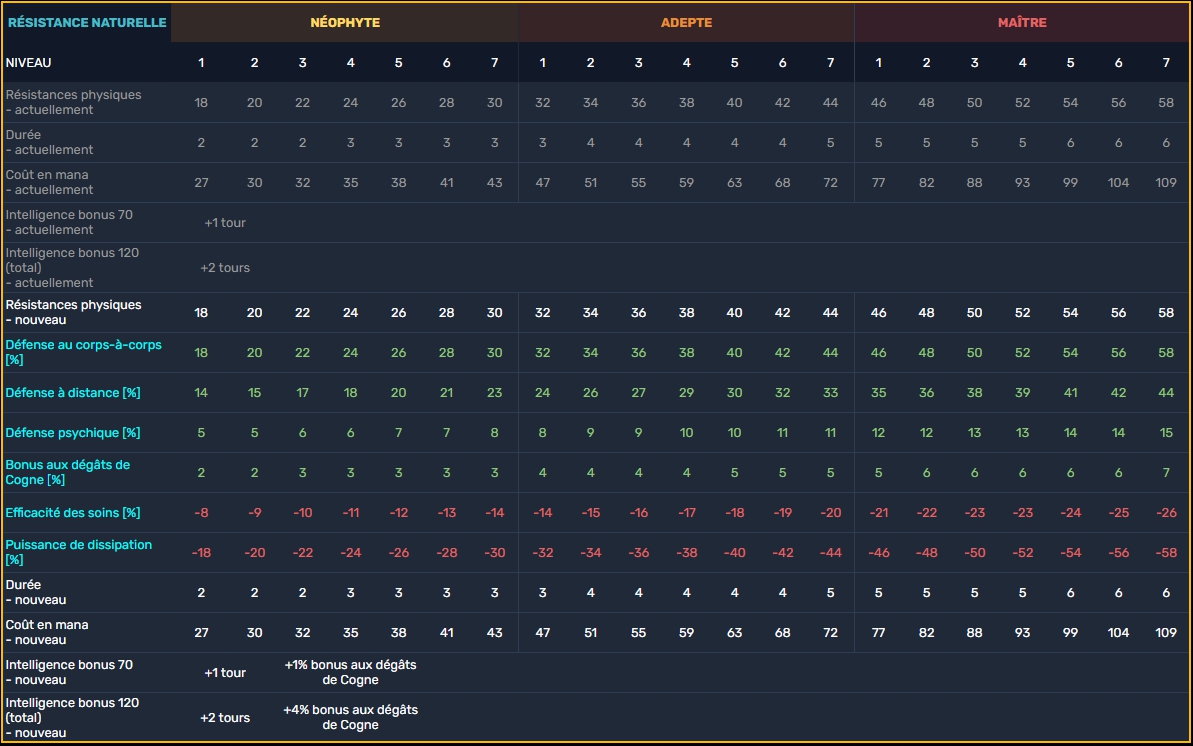
Nous voulons ainsi donner à « Résistance naturelle » une importance stratégique bien plus grande. Lancée sur un membre du groupe, elle constituera un puissant outil défensif. Utilisée sur le Druide lui-même, elle lui permettra également d’augmenter son potentiel offensif au prix d’une partie de sa capacité à soutenir le groupe.
Notre objectif est de nous éloigner d’une situation où « Résistance naturelle » est une compétence très linéaire utilisée presque automatiquement et offrant relativement peu. Après ces changements, elle devrait devenir un outil permettant aux joueurs de prendre de véritables décisions stratégiques, aussi bien défensives que liées aux autres compétences du Druide.
Pyromage
Bouclier de feu
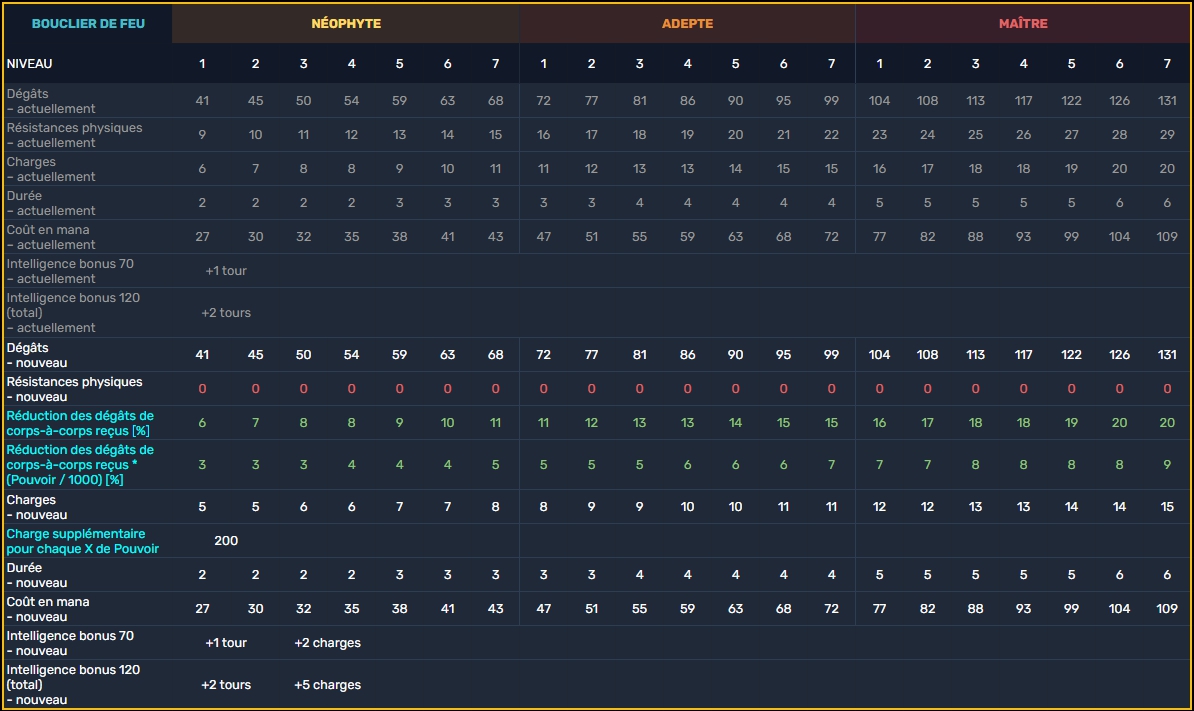
« Bouclier de feu » recevra également une fonction défensive supplémentaire. Après les changements, il réduira les dégâts reçus au corps-à-corps en pourcentage. Cet effet fonctionnera indépendamment de la réduction des dégâts provenant des orbes.
L’efficacité de cette réduction et le nombre de fois où elle pourra se déclencher dépendront du Pouvoir du personnage lançant la compétence. Dans le même temps, nous supprimerons l’actuel bonus fixe aux résistances physiques.
Nous voulons avant tout que « Bouclier de feu » offre au Pyromage et à son groupe une protection plus directe contre une menace spécifique, au lieu d’être simplement une source supplémentaire de bonus généraux aux résistances.
L’effet de renvoi des dégâts restera inchangé.
Météorite
En travaillant sur les changements du Pyromage, nous sommes également revenus sur « Météorite ».
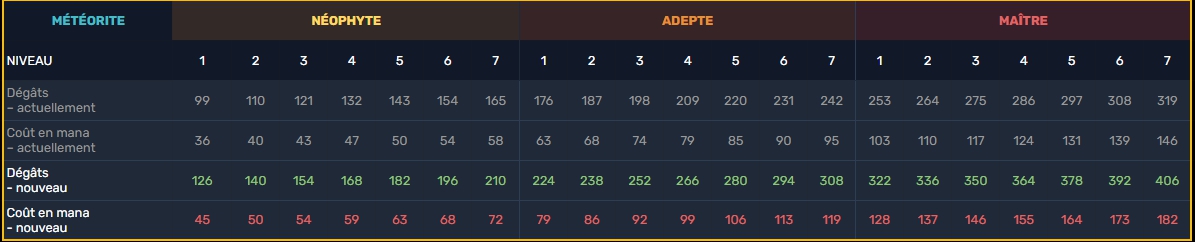
Nous augmenterons ses dégâts, mais son coût en mana augmentera également. Nous voulons que l’utilisation de « Météorite » soit plus puissante et satisfaisante, tout en conservant un coût en ressources approprié. Ses paramètres actuels, associés au fait que des modificateurs comme la chance de double attaque ou la chance de coup critique ne l’affectent pas, faisaient de « Boule de feu » le meilleur choix dans la plupart des situations.
Chaman
Aura d'ombre
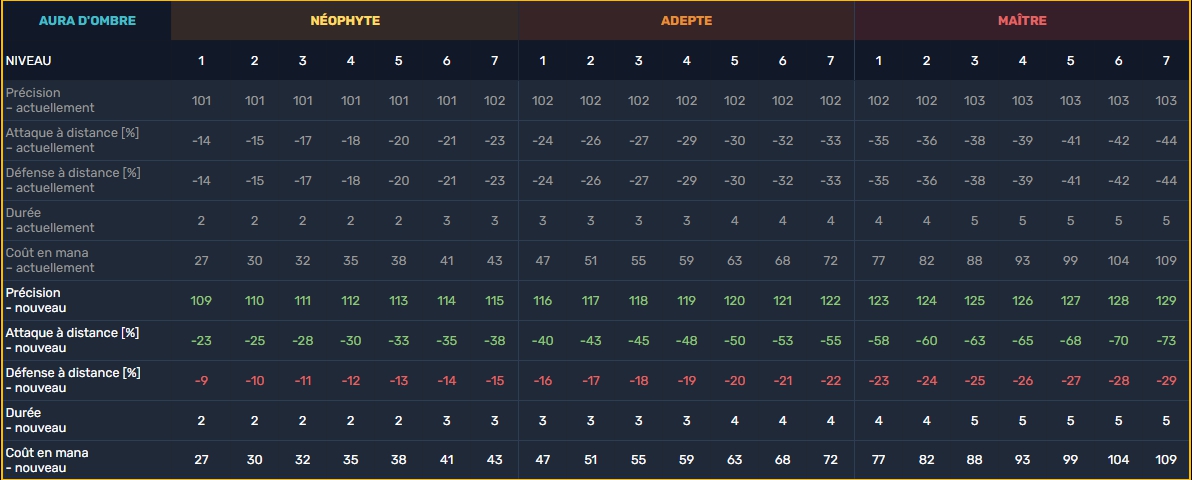
« Aura d'ombre » sera davantage orientée vers le soutien défensif du groupe.
Actuellement, ses valeurs font que la compétence réduit la précision et la défense de la cible dans des proportions à peu près équivalentes. En conséquence, son efficacité peut sembler médiocre. Nous voulons modifier ces proportions et orienter davantage la puissance de l’Aura vers la protection du groupe du joueur. Autrement dit, nous augmenterons considérablement la pénalité de précision à distance tout en réduisant légèrement la pénalité de défense à distance.
Révélation mortelle
Nous n’avons pas non plus oublié « Révélation mortelle ». L’implémentation de ces changements s’est révélée plus complexe que prévu, c’est pourquoi ils n’arriveront qu’avec cette mise à jour.
Actuellement, la mort éventuelle de la cible est déterminée au moment où la compétence est utilisée. Plus « Révélation mortelle » est appliquée, plus des jets distincts sont effectués pour déterminer si la cible meurt.
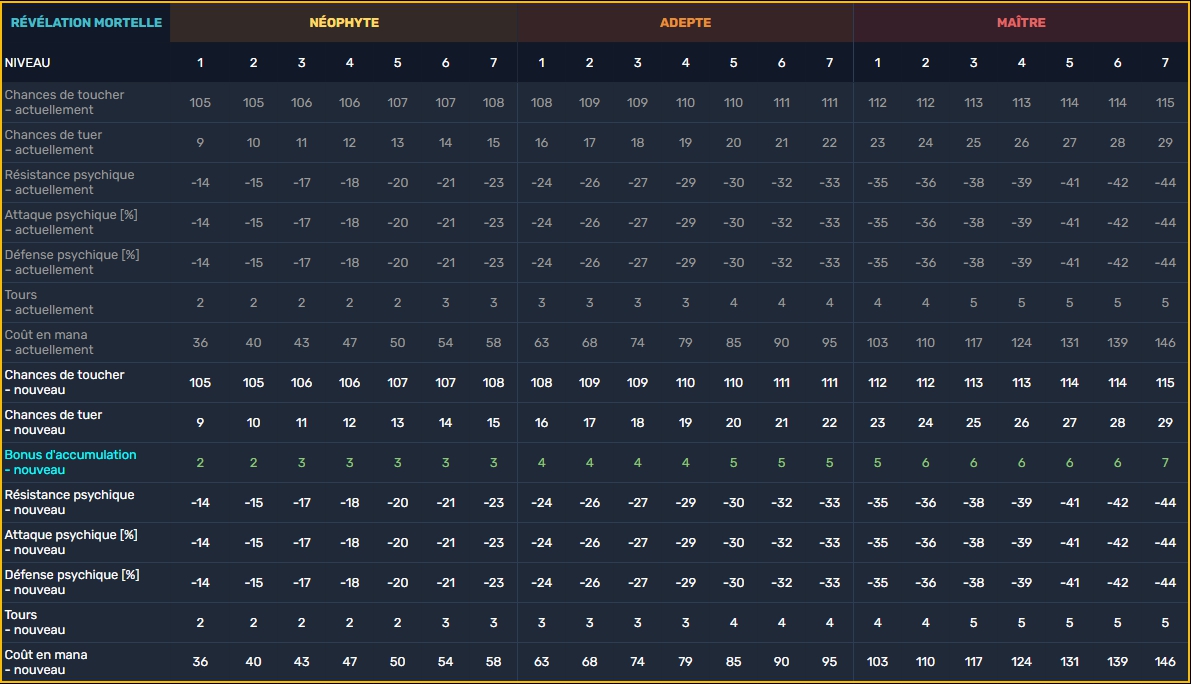
Après le changement, toucher une cible avec la compétence lui appliquera un malus cumulable de l’altération « Révélation mortelle », tandis que le véritable jet de mort instantanée n’aura lieu qu’à la fin du tour, une fois les attaques effectuées et tous les effets affectant le joueur résolus.
Cela donnera à l’adversaire la possibilité de réagir à la menace pendant le tour, par exemple en éliminant tout le groupe adverse et en mettant fin au combat avant que le jet de mort ne soit effectué.
Chaque nouvelle utilisation de « Révélation mortelle » sur une cible déjà affectée par le malus ajoutera un cumul à l’effet, augmentant à la fois sa durée et les chances de tuer l’adversaire lors de la vérification finale. Les utilisations suivantes ne seront donc pas perdues mais renforceront l’effet déjà actif.
Si le jet de mort à la fin du tour échoue, l’altération restera active, mais ses chances de se déclencher au tour suivant seront réduites. Nous prévoyons actuellement une diminution de 20 points de pourcentage après chaque vérification échouée.
Le moment où certains effets associés sont pris en compte changera également. Le drif Lun ne sera pris en compte que lors de la vérification finale de « Révélation mortelle », et l’ordre prévu de résolution des effets sera le suivant : attaques → application des cumuls → vérification de la mort de la cible → en cas de mort : vérification du déclenchement du Drif Lun → Drif Verd.
Archer
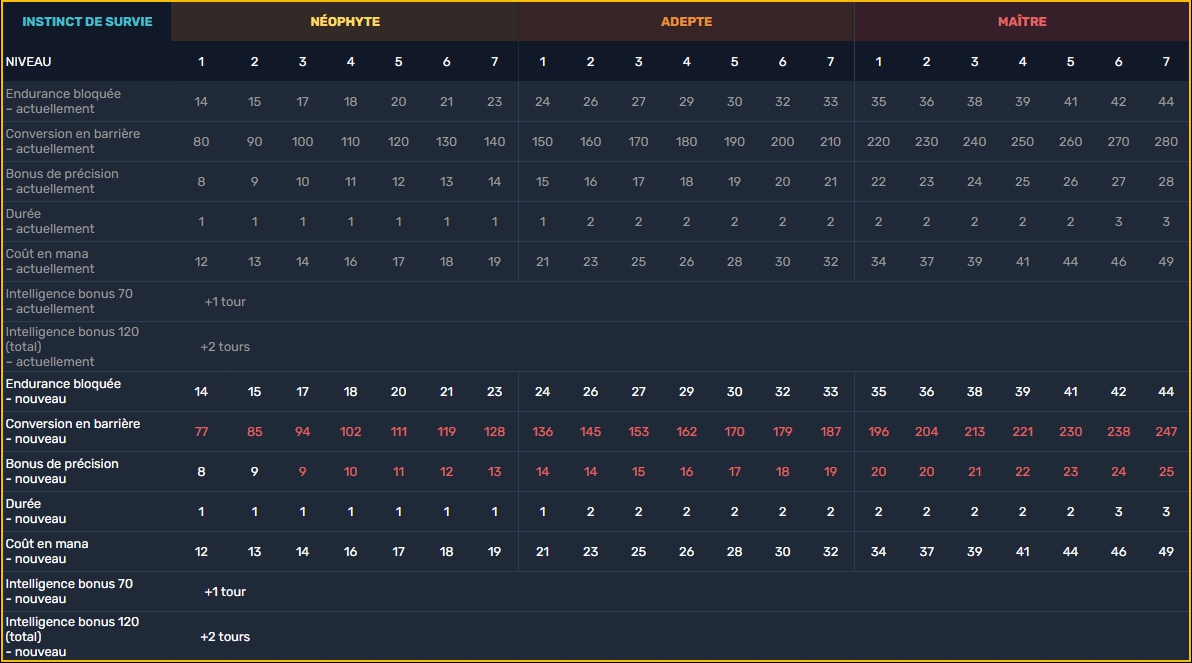
Instinct de survie
« Instinct de survie » restera la principale mécanique d’urgence de l’Archer, mais sa croissance actuelle permet, dans certaines situations, d’atteindre relativement facilement son efficacité maximale et de récupérer très rapidement une grande partie du bouclier.
Nous modifierons la compétence afin qu’atteindre son efficacité maximale nécessite un investissement plus important en points de compétence. Nous ne voulons pas diminuer la puissance d’« Instinct de survie », mais notre objectif principal est d’accentuer la différence entre un investissement modéré dans la compétence et son développement poussé.
Pluie de flèches
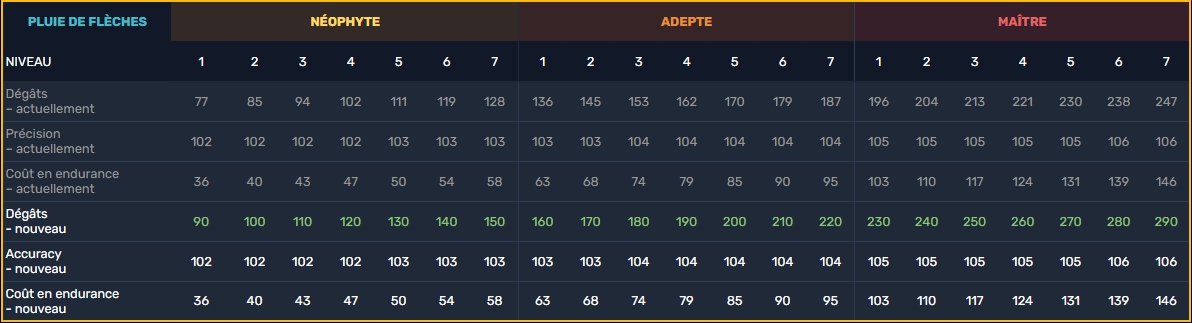
Dans le cadre des changements apportés à l’Archer, nous augmenterons également les dégâts infligés par « Pluie de flèches ».
Sheed
Esquive
Pour « Esquive », l’orientation est plus simple et concerne principalement les valeurs.
Nous réduirons les chances de réussir la première esquive, ainsi que la probabilité de réussir les esquives suivantes au sein d’une même séquence.
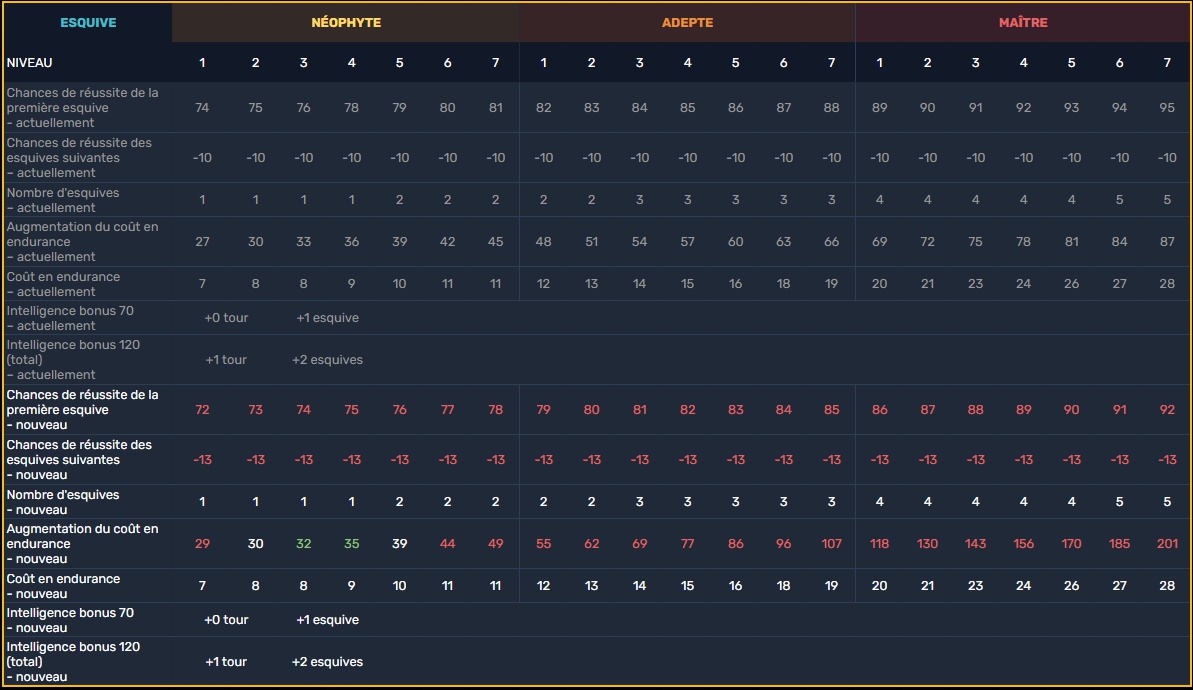
La compétence doit rester l’un des éléments caractéristiques de la défense du Sheed, mais nous voulons réduire les situations où une série d’esquives consécutives influence trop fortement le déroulement de tout un tour.
Barbare
Déchaînement
Avant tout, « Déchaînement » recevra un nouvel effet : une chance d’esquiver une attaque psychique. Le bonus de défense psychique, qui ne fonctionne pas particulièrement bien sous sa forme actuelle, sera supprimé.
La compétence pourra également être utilisée sur d’autres joueurs.
L’effet réduisant le niveau des effets négatifs restera inchangé.
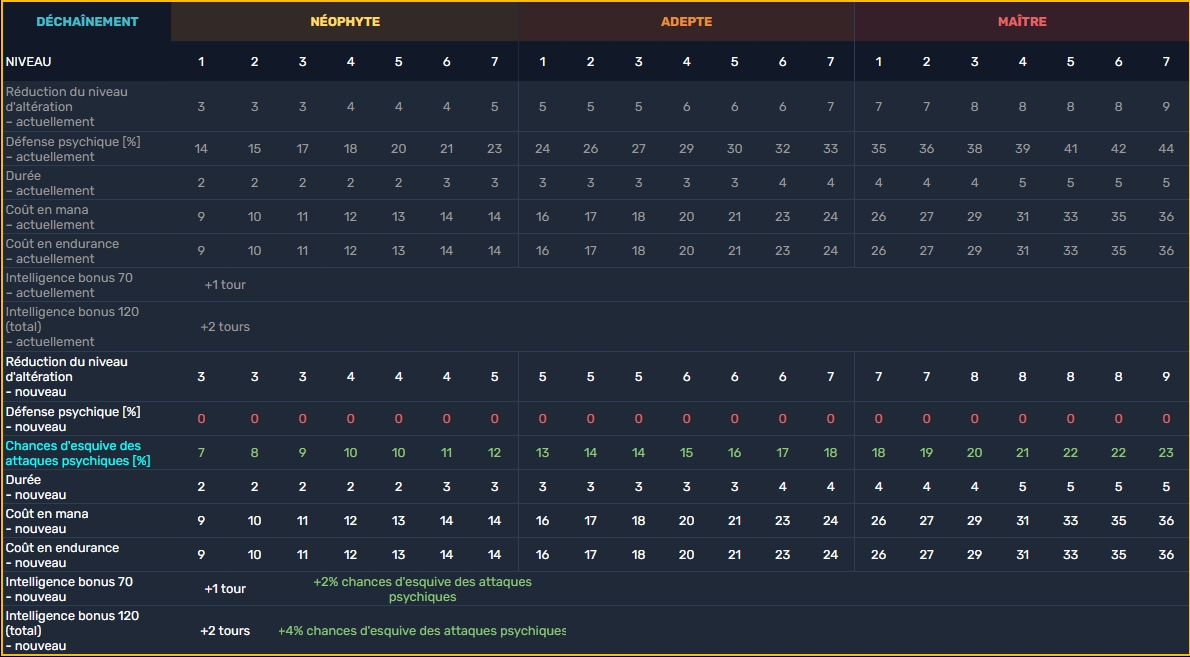
« Déchaînement » ne sera donc plus un outil principalement centré sur le Barbare lui-même, mais deviendra également un renforcement pouvant servir à protéger un membre spécifique du groupe lorsque la situation l’exige.
D’abord le PTR
Avec autant de changements, nous ne voulons pas nous appuyer uniquement sur des tests internes.
C’est pourquoi nous prévoyons d’ouvrir un PTR sur lequel vous pourrez tester les nouvelles compétences défensives en conditions réelles. Nous accorderons une attention particulière aux situations où les nouveaux effets créent des combinaisons nettement plus puissantes ou plus faibles que prévu, et nous recueillerons également vos retours sur les différentes classes.
Nous annoncerons bientôt la date de début des tests. À l’ouverture du PTR, nous fournirons également des valeurs plus précises pour les compétences.
Il y a de plus en plus d’or
Le deuxième grand sujet du DevBlog d’aujourd’hui concerne l’économie.
Depuis plusieurs mois, nous observons une accélération nette et durable de la croissance de la quantité d’or en circulation. Il s’agit en partie d’une conséquence naturelle du développement du jeu : les personnages deviennent plus puissants, terminent plus rapidement les contenus qu’ils connaissent déjà et se concentrent de plus en plus sur les activités les plus rentables.
Le problème commence lorsque, sur une période prolongée, les sources générant de l’or prennent systématiquement le dessus sur les mécanismes qui le retirent de l’économie. C’est exactement la situation à laquelle nous sommes actuellement confrontés. Il ne s’agit pas d’une fluctuation à court terme, mais d’une tendance que nous observons depuis plusieurs mois et qui continuera à s’accentuer sans réaction appropriée.
En conséquence, l’or perd progressivement de sa valeur. Cela se remarque surtout pour les objets dont l’offre est limitée : plus il y a d’or en concurrence pour un même nombre de marchandises, plus la pression sur leurs prix est forte. Cela concerne notamment certaines marchandises échangées entre joueurs et, surtout, les Coffres de platine.
C’est pourquoi nous avons cette fois décidé de prendre des mesures plus importantes que celles que nous appliquons habituellement dans le cadre des ajustements d’équilibrage. Certains de ces changements pourront être clairement perceptibles, mais compte tenu de l’ampleur et de la durée de la tendance actuelle, de petites corrections ne suffiraient pas. Notre objectif est de rapprocher le rythme de génération de l’or de celui auquel il est retiré de l’économie et de limiter sa dévaluation future.
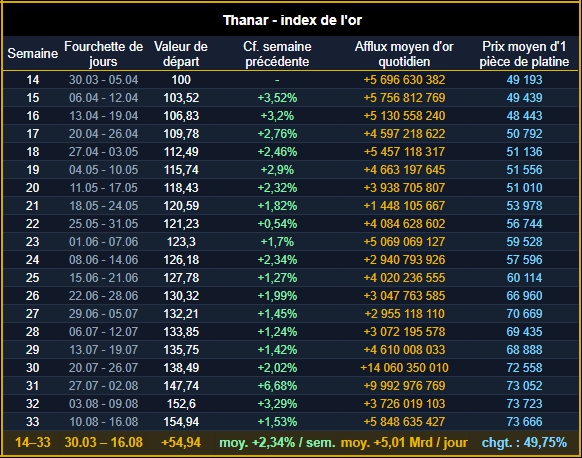
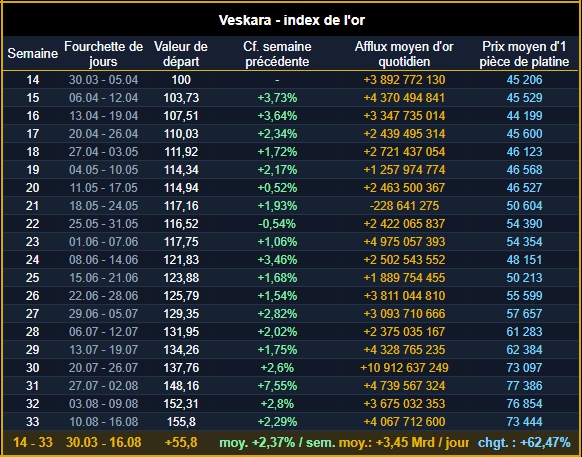
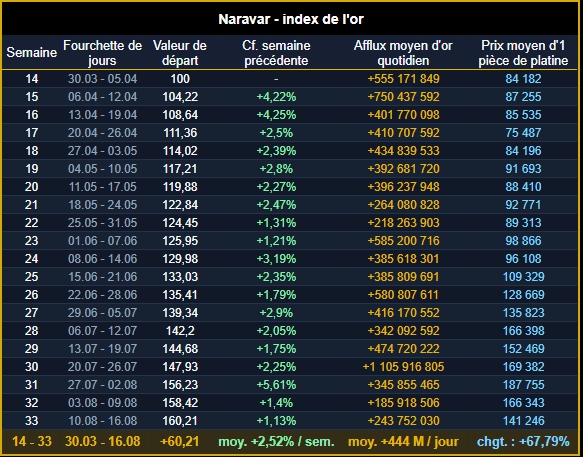
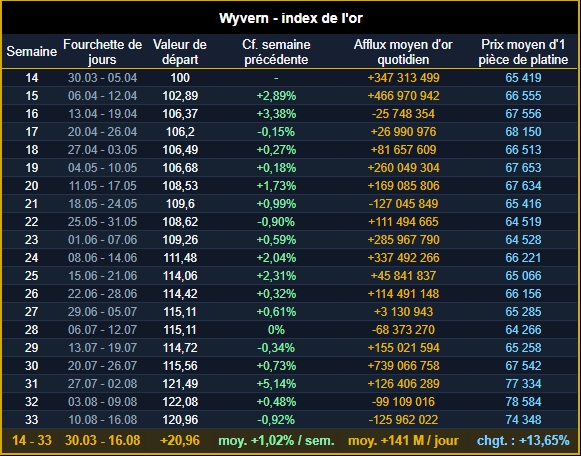
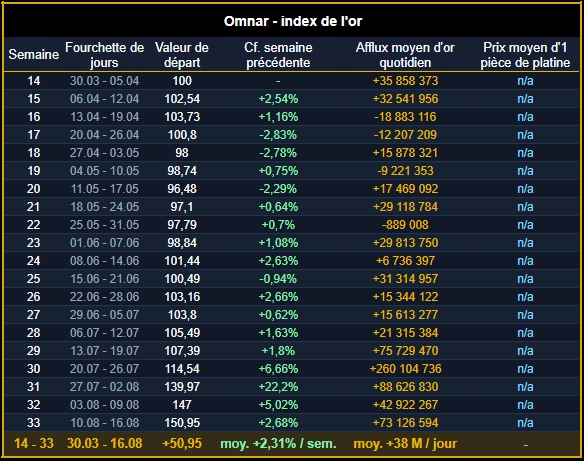
Nous préparons deux étapes de changements. Nous souhaitons vous présenter dès maintenant la première, car elle concerne plusieurs sources et mécanismes précis de retrait de l’or. Nous dévoilerons le périmètre de la deuxième étape ultérieurement, lorsque nous serons prêts à en présenter les détails.
Daily Challenges
Défis quotidiens
Le premier changement concerne les Défis quotidiens.
Pour les personnages de niveau 140, nous réduirons la quantité d’or obtenue aussi bien pour les défis individuels que pour la récompense principale accordée après en avoir terminé une série de quatre.
Toutefois, dans le même temps, nous augmenterons les récompenses en expérience et en psychoexpérience provenant des défis pour toutes les plages de niveaux. Ainsi, cette activité générera moins de monnaie tout en contribuant davantage au développement du personnage.
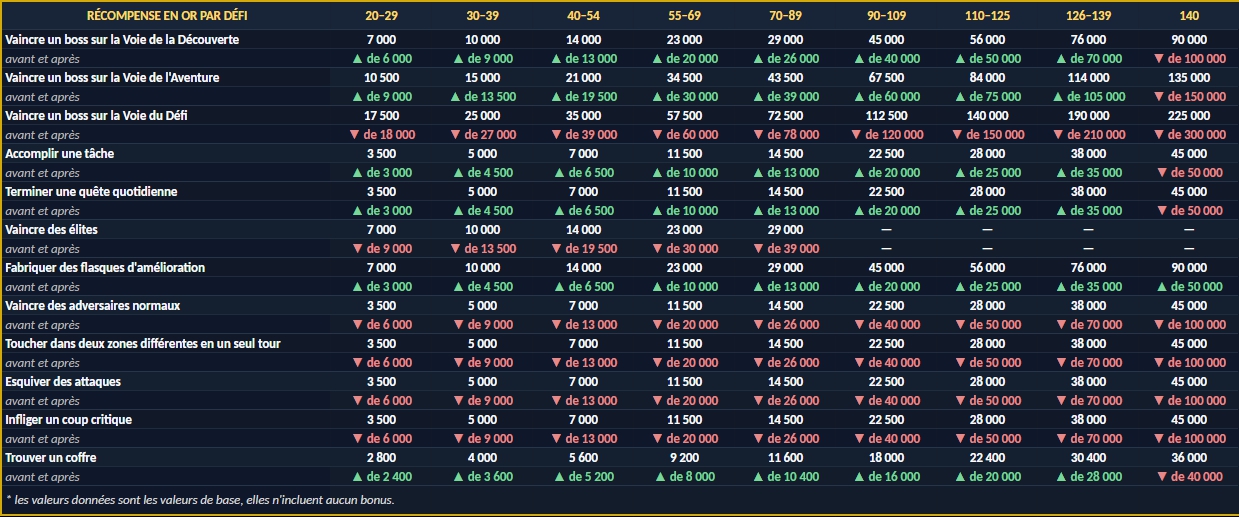

Les Défis doivent rester une composante attrayante d’un jeu quotidien. Mais nous ne voulons simplement pas qu’ils constituent une source aussi importante d’or aux niveaux les plus élevés.
Taxe du Marché
Le deuxième élément sera une augmentation de la taxe appliquée aux offres de vente sur le Marché.
Le taux standard actuel est de 3 % et peut être réduit à 1,5 % lorsque le renforcement est actif. Après les changements, ces valeurs passeront à 5 % sans le renforcement et 3 % avec le renforcement actif.
Le Marché offre aux joueurs un moyen très pratique et sûr d’échanger entre eux, tandis que les frais actuels sont relativement faibles par rapport aux avantages qu’il procure.
Dans le même temps, cette taxe joue un rôle très important : contrairement à un simple transfert d’argent entre deux joueurs, elle retire une partie de l’or de la circulation. Cela signifie évidemment des bénéfices légèrement inférieurs sur les ventes, mais cela crée également un mécanisme permanent de retrait d’or dont l’importance augmente avec l’activité commerciale du serveur.
Couronnes et prix associés
Nous modifierons également le prix des Couronnes achetées contre de l’or, qui passera de 4 000 à 5 000 pièces d’or l’unité.
Dans le même temps, nous ajusterons leur prix d’achat en platine afin de rendre cette option plus compétitive qu’elle ne l’est actuellement. Dans les conditions économiques actuelles, l’achat contre de l’or devrait toutefois rester l’option la plus rentable. Le prix unitaire passera de 0,2 à 0,12 platine.
Cependant, les prix d’achat et de revente de certains familiers disponibles contre des Couronnes seront réduits, notamment ceux des familiers à usage unique, des chiens, du corbeau noir et du singe rouge.
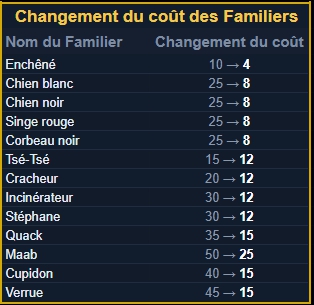
Il est important pour nous d’éviter qu’un stock important de Couronnes constitué avant la mise à jour permette ensuite de réaliser facilement des bénéfices. Cela serait particulièrement simple puisqu’il n’existe aucune limite au nombre de Couronnes pouvant être accumulées.
C’est pourquoi nous effectuerons une conversion unique lors du déploiement de la mise à jour.
Toutes les offres d’achat et de vente actives de Couronnes sur le Marché seront annulées et les frais payés lors de leur mise en vente seront remboursés. Ensuite, toutes les Couronnes détenues par les personnages ou stockées dans les dépôts seront converties en or selon le taux actuel de 1 Couronne = 4 000 pièces d’or. L’or sera placé au même endroit que celui où se trouvaient les Couronnes correspondantes.
Les joueurs concernés par cette conversion recevront également un message les informant que l’échange a été effectué.
Ainsi, tout le monde commencera à fonctionner selon le nouveau taux dans les mêmes conditions, sans pouvoir exploiter l’annonce du changement elle-même à des fins de spéculation.
Mort au niveau 140
Enfin, nous avons un changement qui relie l’économie à un problème relevant directement de la jouabilité.
Au niveau 140, le système actuel de pénalité de mort présente une faille importante. L’expérience cesse de représenter un coût significatif pour une raison évidente : le personnage ne peut pas redescendre de niveau. Dans le même temps, les joueurs peuvent limiter la quantité d’or portée directement par leur personnage et ainsi réduire considérablement les conséquences des morts consécutives.
Nous voulons corriger cette mécanique.
La pénalité de mort des personnages de niveau 140 sera plus élevée, et la somme due sera prélevée à la fois sur le personnage et dans le dépôt qui lui est attribué. Au niveau 140, la pénalité dépendra de la Puissance du joueur. Les joueurs les plus faibles, en-dessous de 10k de Puissance, paieront environ 18% de plus qu’actuellement. Pour les joueurs entre 10k et 20k de Puissance, le coût statistique d’une mort augmentera de 38% à 65% par rapport au système actuel. Le changement le plus important concernera les joueurs au-dessus de 20k de Puissance : pour eux, le coût d’une mort augmentera de 92% à 110% par rapport aux valeurs actuelles. Déplacer simplement son or hors de l’inventaire ne permettra donc plus d’éviter le coût de la mort.
Mais que se passera-t-il si un joueur ne dispose réellement pas de suffisamment de fonds ?
Dans ce cas, la mort sera considérée comme impayée et le personnage recevra une altération spéciale. Tant que la somme due n’aura pas été entièrement remboursée, les combats ne rapporteront plus d’or, de psychoexpérience, et de points de maîtrise pour l’infusion, tandis que les chances d’obtenir de l’équipement sur les ennemis seront réduites de 50%.
L’or obtenu sur les ennemis ne sera cependant pas perdu. Il sera automatiquement utilisé pour rembourser la pénalité restante jusqu’au règlement complet de la dette.
L’altération pourra également être supprimée auprès du PNJ approprié en payant la somme due ainsi qu’un petit supplément.
L’idée est simple : ne pas avoir d’or au moment de mourir ne doit pas constituer un avantage, mais nous ne voulons pas non plus créer une situation dans laquelle un personnage sans ressources se retrouverait définitivement bloqué. Les joueurs auront toujours la possibilité de rembourser leur dette envers la Mort simplement en continuant à jouer.
Parallèlement à ce changement, nous réduirons considérablement la pénalité de mort non matérielle actuelle, que beaucoup d’entre vous trouvent particulièrement pénible et dont vous nous avez souvent demandé l’allègement : le temps qu’elle prend. Nous réduirons fortement la durée d’affichage des cartes et ajouterons une option de tirage automatique. Une fois l’option correspondante activée dans les paramètres, vous n’aurez plus besoin de cliquer manuellement sur une carte après chaque mort.
Ce n’est que la première étape
Les changements économiques décrits ci-dessus ne constituent pas une tentative de « régler l’inflation » en une seule fois. L’économie d’un MMORPG est un système composé de mécanismes interconnectés, et chaque intervention exige que nous observions la manière dont les joueurs y réagissent.
C’est pourquoi nous préférons procéder par étapes : réduire certaines des sources les plus visibles d’excès d’or, renforcer plusieurs mécanismes naturels de retrait d’or devenus moins efficaces parce qu’ils avaient été conçus pour d’autres conditions économiques, puis évaluer les résultats avant de passer à l’étape suivante.
Nous présenterons le deuxième ensemble de changements séparément.
Mais avant cela, le PTR et les tests des nouvelles compétences nous attendent. Nous comptons sur votre aide, en particulier sur celle de ceux qui exploitent depuis des années tout le potentiel de leurs classes et qui trouveront probablement des combinaisons que nous n’avons jamais anticipé ;)
À bientôt sur le PTR et dans le prochain DevBlog !