Greetings Taernians,
The end of the year brought us the latest update, along with a huge influx of questions and feedback. Exactly the way we like it.
That is why this Dev Blog takes a slightly different form than usual. We have collected your questions about the most recent update and are treating this entry as a dedicated Q&A, where we address the topics that came up most often.
You will find community-submitted questions highlighted in orange, with the team’s answers placed directly below each one.
There is a lot of material to cover, so we will not stretch this post with a lengthy introduction. Let’s get straight to the point.
Why is it not possible to rest in the arena?
The lack of a resting in the Trials is a deliberate design decision. This mode is meant to be a place where proper preparation for combat and conscious resource management truly matter.
Over recent years, many mechanics have been added to the game that allow players to recover health, mana, or stamina during combat. As a result, the role of potions has been significantly reduced. Potions are easy to obtain through platinum chests, and many players have large stockpiles sitting unused in their inventories, often with no real opportunity to spend them. The Trials of the Lodge are one of the few places where using potions once again makes sense and has a real impact on gameplay.
It is also worth noting that players who do not want to rely on potions have an alternative. The Weekly Challenges buff allows resting throughout the entire game regardless of area color, including the Trial arenas. Thanks to this, the Weekly Challenges system gains additional importance, increasing its appeal and encouraging players to reach the threshold required to claim these buffs.
Which orbs against specific enemy types (e.g. bosses) work in the arena?
Orbs are applied based on the type of the enemy party, not the type of an individual opponent. Throughout the entire game, the rule is simple. If there is no crown above an enemy party, then orbs against regular enemies apply in that fight, so they are the ones active during all battles in the Trials.
I cannot defeat party X or Y, and party Z is too strong for my bracket. What should I do?
Level brackets are designed in a way that moving up to a higher bracket does not completely block player progress. The enemies in the first few arenas of a given bracket are balanced to match the difficulty of the final rooms from the previous bracket’s Trials. With bugfix 9.55.1, we also introduced additional changes to ensure that advancing to a new bracket does not result in a situation where a player is unable to clear any room at all.
If players still experience difficulties defeating the initial enemy parties within a bracket, or even in the bracket below where the Trials begin, it usually means that the character requires more work. This may include improvements to equipment, upgrade levels, skill selection, better route planning during the Trials, more effective use of mechanics that support characters in the Trials, or the need to learn the tactics and behavior of specific opponents.
We treat such cases as edge scenarios and they should not affect the majority of players. Under normal circumstances, there should always be at least one path that allows for continued progression, even if it requires temporarily stepping away from the Trials to strengthen the character before attempting them again.
How does Rage interact with passive damage now?
Is the damage reduced first and then affected by Iori, for example receiving 1000 passive damage, applying Rage on A7 which reduces damage by 500, then applying a 30 percent Iori reduction to the remaining 500 for a final result of 350 damage? Or is it applied the other way around, meaning 1000 minus 30 percent from Iori and then minus 500, resulting in 200 damage taken? With the recent nerfs to Rage-based defense, will the Iori drif have its intensity reduced?
When it comes to passive damage, all reductions are applied in a strictly defined order.
- First, the base amount of damage the player would receive is determined, for example 1000 HP.
- Next, the percentage-based modifier from the Iori drif is applied. With a 30 percent reduction, the calculation looks like this:
1000 HP × (1 − 30 percent) = 700 HP. - Only then is the flat reduction from the skill applied, for example minus 500 HP.
As a result, the player takes 200 damage in total, following the sequence 1000 to 700 to 200.
As for the intensity of the Iori drif, we do not currently plan to reduce it at this time. Our approach to power balance is that the greater a drif’s real usefulness in gameplay, the higher its intensity should be. Since the recent changes give Iori additional relevance for passive damage as well, there is even less reason to lower its intensity.
Are you considering adding the option to enter a lower level bracket? Right now, deliberately dying in the final room is often more profitable than advancing.
We see this issue and understand why, under the current model, some players choose to intentionally not complete the final arena of a lower bracket instead of advancing. This is exactly why, in bugfix 9.55.1, we introduced changes such as lowering the entry cost for Trials at level 140, reducing the Might of enemy parties in the early arenas of each Trial, and moving the arena with an additional reward to an earlier stage of the map. The goal of these changes was to reduce the risk associated with advancing and to make playing at your current level bracket more profitable.
From a balance perspective, we assume that a player who has completed a Trial in a lower bracket should be able to regularly reach at least arena 6 or 7 in the higher bracket. With the current reward distribution, this level of progress statistically generates a higher profit than fully completing a Trial at a lower level, where completion means clearing 12 out of 13 arenas, even despite the higher entry cost.
At the same time, we are aware that players’ subjective experiences may differ, especially with a smaller number of attempts, where randomness and individual outcomes play a significant role. At this stage, we believe we need a larger data sample in order to better assess trends following bugfix 9.55.1.
We also understand the situation of players who advanced to a higher bracket without fully understanding the advancement mechanics and as a result lost the ability to play at a lower difficulty level. Compared to players who were aware of this in advance and intentionally avoided advancing, this can feel unfair. However, this is a consequence of the current progression system rules, not an intentional attempt to punish specific players.
Ultimately, our goal is a model in which the vast majority of players want to play in their appropriate level bracket because it is the most profitable and natural choice for them. Remaining in a lower bracket despite being able to advance should apply only to a narrow set of specific cases, such as characters who do not yet meet all requirements, and should not become a common or optimal strategy.
After the New Year, based on the data we collect, we will make a decision regarding potential further adjustments. If, after a longer period, deliberately avoiding advancement still proves to be more profitable, we will treat that as a clear signal that additional changes are necessary.
Will we get a breakdown of the buffs? I received the “defensive psycho-effect enhancement” buff, and the only thing that increased was my critical hit resistance. Alorn wasn't affected, so is Alorn not defensive?
The Alorn drif belongs to the “reduction” category. There was an error in the description of this Trials buff, which we corrected in bugfix 9.55.1. When it comes to identifying specific drif or orb categories, you can use the filters in the marketplace under the artifacts tab. The dropdown lists clearly show all available categories. After selecting one, the marketplace will display the listed drifs or orbs that match the chosen criteria. Effects coming from other sources, such as synergetics, are classified into the same categories as their artifact equivalents.
Do arena enemies count toward the boss pool for guaranteed drops? Does obtaining rare gear in the arena reset the guaranteed drop counter?
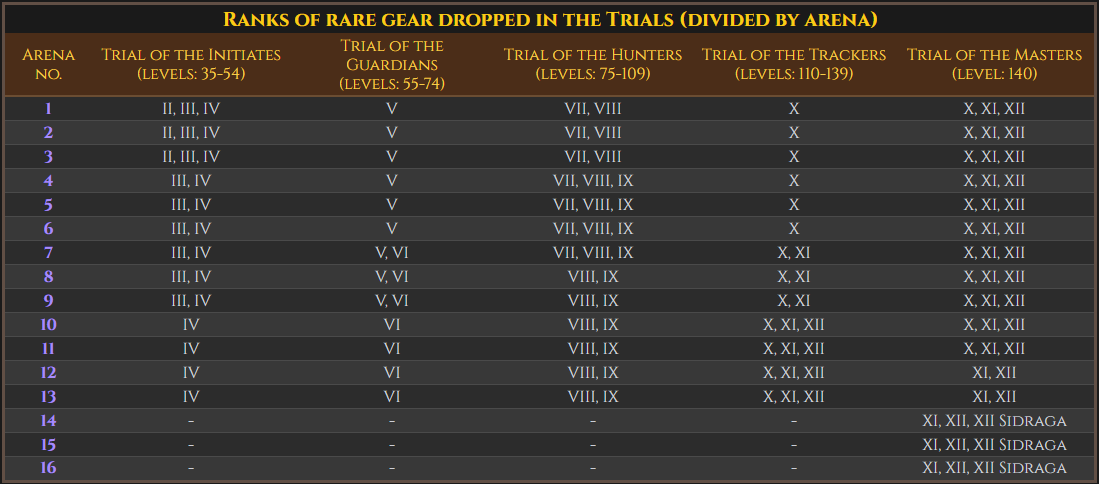
Yes, every enemy encountered in the Trials counts toward the guaranteed drop counter. Which specific counter is increased when no gear drops, or reset when rare gear is obtained, depends on the range of rare gear tiers that can drop from a given enemy.
To answer the follow-up question of what drops where, we are also providing a table that outlines rare equipment drops in the Trials, broken down by Trial type and arena number.
Are you planning to add the ability to revive pets?
During testing of the Trials, we observed that pets have a significant impact on gameplay balance, and allowing them to be revived could further disrupt that balance, especially in the early stages. For this reason, we decided not to introduce this option for now, but we are not ruling it out in the future.
If, after further observation and potential balance adjustments, we determine that pet revival can be introduced in a way that is safe for gameplay, for example with appropriate limitations, we will return to this topic.
Are you considering increasing the number of entries? We waited a long time for new content, and the amount of gameplay we received feels quite limited for an entire week.
At this moment, we believe that the current entry limit is well balanced. Our goal was for the Trials to be an activity players return to week after week, rather than content that can be fully farmed in a short period of time.
We intentionally prefer to leave a sense of anticipation and motivation to come back the following week, instead of significantly increasing the number of entries at the cost of the mode’s long term longevity. The current limit also allows us to set rewards at a higher and more attractive level, without risking negative effects on the game’s economy.
We understand that after waiting a long time for new content, some players would like to spend more time in the Trials. We will continue to monitor how quickly players use their available entries and what overall sentiment develops in the coming weeks. If it turns out that the limit genuinely restricts enjoyment rather than enhancing it, we will revisit the topic and consider adjusting the limit or introducing an additional way to increase the number of available entries.
Will the next birthday event be based on the Challenge Arena system?
No. The birthday event will remain in the same or a very similar form to how it worked in previous years.
Why do enemies in rooms 10 and above sometimes appear without aspects, making aspect-related mechanics ineffective?
Currently, aspects are assigned only to elite, champion, and boss enemies. As a result, when a regular enemy is selected during party generation in the Trials, it will not receive an aspect. This is something we are aware of and actively monitoring, and it is possible that adjustments to this system will be introduced for arena-based content in the future.
Are you planning to make changes to the gold costs for entering the Trials and upgrading stats? They feel quite high, especially on lower population servers.
As part of bugfix 9.55.1, we reduced the cost of entering the Trials at level 140. This was a response to early observations regarding profitability and the entry barrier for this mode.
At this time, we are not planning any further reductions to gold costs, either for entering the Trials or for upgrading stats. It is important to us that the costs associated with the Trials carry real weight and meaning, rather than being purely symbolic. At the same time, we assume that with the current level of rewards and progression, the mode will be attractive and popular enough for these costs to feel justified.
We understand that on lower population servers, higher costs can be felt more strongly. We will continue to monitor whether this actually translates into limited access to the Trials or blocked progression. If it turns out that gold costs genuinely prevent meaningful participation in this mode, we will revisit the topic.
Why does aspect scaling apply only to bosses, champions, and elites?
We wanted this mechanic to specifically support players when facing the most challenging opponents. Regular enemies generally do not fall into that category, which is why we decided to limit its effect to bosses, champions, and elite enemies.
Why is the route we will follow not visible before entering? It would help with better preparation for the upcoming challenges.
This is a deliberate design decision. We want to preserve an element of randomness and unpredictability, which is one of the core pillars of the Trials. If the route were visible before entry, players could selectively choose only those layouts with the highest chance of success. In practice, this would reduce gameplay variety and lower replayability.
Additionally, within the Trials, Arenas of Bargain include mechanics that allow players to reroll selected elements on the map. Their appeal is based on reacting to an unknown layout and making decisions during the run. Revealing the full route in advance would significantly reduce the purpose and value of these mechanics, turning them into tools for adjusting a known scenario rather than responding to dynamic conditions.
For this reason, preparation for a Trial should primarily be based on the overall readiness of the character and party to face a wide range of challenges, rather than optimizing for a specific, pre revealed layout. This ensures that each Trial retains a sense of freshness, and that decisions made during the run have a meaningful impact on the outcome.
Will the arena continue to be developed, or will it only receive balance adjustments?
For now, we are primarily focused on collecting data following the introduction of the Trials. This is a new mode, and we want to give it some time to settle so we can see how it is actually being played and what issues players encounter in practice.
Balance remains a top priority for us, which is why we are first analyzing how the mode performs across different level brackets. At the same time, we have our own list of areas and mechanics that require closer inspection and evaluation over a longer period.
Further development of the Trials, such as new modes or additional mechanics, is not off the table, but at this stage it depends on the results of these observations.
Do aithar bonuses affect pets? If not, should they?
No, bonuses from aithars do not currently affect pets. The aithar mechanic was designed as a direct enhancement for the character itself, which is why it does not apply to pets.
At this time, we are not planning to link aithars with pets. If a clear need or a meaningful direction for development emerges in this area, we will certainly take it into consideration.
Will it be possible for players from a lower or higher level bracket to participate in party instances?
Party Trials are divided into level brackets, and players can only take part within their own bracket. This is intended to maintain a fair difficulty level and to prevent situations where stronger players carry weaker ones.
The issue of boosting is important to us and already occurs in some parts of the game, which is why we approach any mechanics that could amplify it with great caution. For this reason, we do not plan to allow players from different level brackets to be mixed within group instances.
Does the reset from Weekly Challenges also reset entries for the Trials?
No. Daily or weekly task resets do not affect the number of available entries to the Trials. We are not planning any changes in this area.
Why is the difference in rewards between T4 and T5 so small? While the psycho rewards feel reasonably balanced, the gold entry cost compared to the rewards feels underwhelming, and the aithar rewards are at least twice as low as expected.
We understand where the perception that the reward difference between T4 and T5 feels small comes from, especially when looking at individual runs or short series of attempts. In practice, this impression is exactly what leads some players who could comfortably handle T5 to remain in T4, assuming it to be more economically efficient.
Statistically, however, T5 performs better. The average profit from a T5 Arena equals a full clear of a T4 Arena after roughly six T5 rooms. Every additional room beyond that point represents pure profit compared to T4.
It is also worth looking at the raw aithar numbers.
- One room in a T5 Arena grants 20 Aithars.
- One room in a T4 Arena grants 12 Aithars, with the final room granting 60.
In theory, fully completing a T4 Arena results in 204 Aithars. In practice, however, once a player finishes T4, they advance to T5 and can no longer return to T4. This means that realistically, a player can complete only 12 out of the 13 available rooms, resulting in a gain of 144 Aithars.
Under this scenario, the number of aithars gained from T4 becomes comparable to what a T5 Arena offers after roughly seven rooms, which is 140 Aithars. Every additional T5 room increases that advantage further.
Difficulty is another important factor. The average Might settings of enemies mean that rooms 1 to 7 of a T5 Trial roughly correspond to rooms 8 to 13 of a T4 Trial. This means that players who consistently clear the later stages of T4 are effectively facing a very similar challenge in T5, while having access to higher reward potential.
The feeling that T4 has better economics very often comes from RNG and a small sample size. With a limited number of entries, individual weaker T5 runs are felt much more strongly, while longer series of attempts clearly show T5’s advantage. This is a natural effect of drop variance rather than a real difference in reward settings.
From our perspective, players who are ready for T5 remaining in T4 is an undesirable outcome, as it leads to incorrect conclusions about profitability and disrupts the natural progression of difficulty. T5 was designed as the next step in both challenge and economy, and over a longer timeframe it fulfills that role.
That said, we will continue to observe player behavior and collect data from a larger number of runs. If it turns out that T5 does not meet its intended goals after all, we will look for safe adjustments that correct the situation without negatively impacting the game’s economy.
Why are aithars so scarce overall?
Aithars are a new currency tied to new mechanics, which is why their availability is intentionally limited at the start. We prefer to begin with a lower acquisition rate and increase it if needed, rather than create a situation where new content can be fully farmed within just a few weeks.
In Broken Ranks, progression systems are designed with long term development in mind. Reaching subsequent milestones is meant to be a process spread over time, not something completed within a few days or weeks of intensive play.
This approach also gives us greater control over balance. It allows us to react and adjust the pace of aithar acquisition once we have a clearer picture of how players are engaging with the new mechanics.
Why does arena-only progression feel so flat overall? The conversion rates should be two or three times higher so that spending aithars on these stats actually makes a difference. At higher levels, it leads to situations where after two weeks of grinding aithars, I can only add two stat points.
We understand that at higher levels, investing aithars can feel underwhelming, especially when focusing on a single stat and looking at the gains point by point. That feeling is natural, but the structure of progression in the Trials is intentional.
The system was designed to discourage maxing out a single stat, particularly health points or key offensive attributes. Builds that rely almost entirely on additional HP or one dominant stat are extremely powerful, and without these limitations they would quickly lead to serious balance and difficulty issues in the Trials.
For this reason, the conversion rates become less favorable the more you invest into a single stat. On the other hand, spreading progression across two or three stats allows players to benefit from better thresholds and results in a higher overall increase in character power, even if individual numbers do not grow dramatically.
The Trials are not meant to be a system for rapidly stacking stats, but rather a long term tool for gradual strengthening and build differentiation. Progression is intended to be felt over time and through synergy across the full stat setup, not as a quick power spike after a few weeks of grinding.
Why is aspect scaling capped at 70 percent of Might?
The aspect scaling mechanic was not designed as a way to speed up farming of content that is already cleared quickly, but rather as support in situations where the player’s strength and the enemy’s strength are more evenly matched.
For the same reason, the 70 percent Might cap was introduced. In most cases, content below this threshold does not pose a significant threat, so further strengthening the player with additional bonuses just to clear it even faster would miss the point.
In the long term, we want to encourage players toward more challenging content, where using aspect scaling will naturally be more rewarding and noticeable. The first opportunity for this approach will be a new instance planned for the first quarter of 2026.
A separate topic is how aspect scaling functions within the Trials. Here, changes are possible that would allow bonuses to apply to all enemies. However, we need to approach this carefully. The current difficulty level of the Trials was balanced without taking this mechanic into account, and any modification requires thorough testing to assess its impact on gameplay.
Why do we not have a physical entry item for the Trials that could drop from Weekly Challenges?
At this stage, we decided not to introduce physical entry items for the Trials that could drop from other sources, such as challenges. Access to the Trials is intentionally based on a weekly refresh of entries and the option to purchase additional attempts using aithars.
This approach allows us to better control the pace of progression and the number of attempts at new content, especially during the initial period after its introduction. Making additional entries too easily accessible could quickly disrupt reward balance and the entire gameplay loop surrounding the Trials.
We want players to have time to become familiar with the mechanics and understand their real impact on character progression. Only after collecting a larger amount of data will we be able to properly assess whether additional entry sources, including physical entry items, are needed and whether they would genuinely improve the gameplay loop rather than destabilize it.
Will it be possible to change the mandatory class slots such as dr/knight, vd/sh/archer, and fire mage/barbarian? It can be difficult to find a druid or a knight.
When introducing mandatory class groups like dr/knight, vd/sh/archer, and fire mage/barbarian, our primary goal was to prevent situations where certain classes would be regularly excluded during party formation. This limitation guarantees each of these classes a permanent place in party compositions and clearly defines their role in party gameplay.
We also wanted parties to have a cohesive and predictable structure that works well in challenges built around cooperation and role distribution. The Trials are designed around this setup, and the difficulty is balanced accordingly.
At the same time, we understand that in practice, especially within certain level brackets or during specific hours, finding a druid or a knight can be more difficult than overall data might suggest.
At this time, we are not planning to change the mandatory class groups, as they are a key element of party composition design in the Trials.
Why are aspect bonuses located in the skills window? They seem like a better fit for the stats window.
Aspect bonuses are neither fully stats nor fully skills. However, based on how they function and how their progression works, we decided they fit better within the skills window.
We are aware that the current PC UI has some inconsistencies and that not everything is placed in the most intuitive way. This is an area we would like to improve as part of larger interface updates.
After the release of the mobile version of Broken Ranks, we plan to revisit the PC UI and UX. At that point, we will most likely also address the placement of aspect bonuses.
Are you planning to balance buffs and debuffs specifically for solo Trials? In party Trials, debuffs can be distributed among classes that are less affected by them. In solo runs, this is not possible, and unlucky debuffs can ruin an entire run.
This is an aspect we will be closely monitoring, as it has a real impact on the effectiveness of solo Trials. We are aware that in party play, debuffs can be spread across classes that are less affected by them, which is something that naturally cannot be done in solo mode.
That said, we have already introduced several solutions aimed at reducing both the randomness and severity of debuffs in solo Trials. In this mode, debuffs are drawn from milder categories or appear at lower tiers, which should make their impact less punishing than in party Trials. Additionally, in party versions of the Trials, a higher number of debuffs must be assigned so that multiple players receive them at the same time.
We will continue to evaluate whether these mechanics are fulfilling their intended role and whether unlucky debuff combinations have too strong an influence on the outcome of solo runs.
Why were the Trials designed mainly with damage dealers in mind?
The Trials were not designed around any specific class or group of classes, including damage dealers. The goal was to create a challenge that tests different aspects of gameplay for all players, rather than favoring a single role.
At this stage, we do not see clear signals in the data that strictly offensive professions perform significantly better in the Trials or consistently progress further than other classes. At the same time, we are aware that early player impressions may differ, especially in a new mode that is still being explored.
We also believe it is too early to draw firm conclusions about any class being favored. As more runs are completed and players become more familiar with the mechanics, the overall picture should become clearer.
Why did players not receive a Skill Reset Token when one of the skills was significantly changed?
In our assessment, the changes made to the Furious Reflex skill were not extensive enough to justify distributing skill reset tokens. We understand that these changes may have been noticeable for some players, but they did not fundamentally alter how the skill functions or its role in gameplay.
We are very cautious about handing out resets, as doing so too frequently with every adjustment would quickly lead to a situation where any balance change automatically comes with an expectation of compensation. We want to avoid that and reserve reset tokens only for cases where changes are truly significant and require a full rebuild of a character.
Why is the death penalty in the arena the same as in standard gameplay? I feel this significantly reduces the profitability and appeal of the Trials.
The death penalty is a standard element of every Trial, and the resources lost as a result are already factored into the overall balance and profitability of the Trials. We assume that every attempt carries a certain level of risk, which is a natural part of this type of challenge.
Death penalties in Broken Ranks are designed to have a meaningful cost without being excessively punishing. Because of this, we did not see a need to reduce them specifically for the Trials, especially since this mode is meant to be demanding and focused on conscious risk taking.
Are you considering allowing players to backtrack in order to choose a different path?
At this time, we do not plan to introduce the ability to backtrack and select a different route. In the Trials, path selection is one of the core pillars of the mode and directly reflects rogue lite gameplay, where decisions made along the way have real and lasting consequences.
We want path choice to be a deliberate decision, not something that can be easily corrected after a failure. The risk involved and the need to adapt to the chosen route are an essential part of the challenge and what sets the Trials apart from standard content.
Do you think druids have too much of an advantage in the Trials because of their healing capabilities?
This is one of the aspects we are currently monitoring. Druids have always performed very well in demanding content, especially in solo play, and this is not something exclusive to the Trials. It mainly stems from the utility provided by Healing and Dispel.
At the same time, this advantage is partially offset by lower offensive potential and accuracy compared to professions that are focused purely on dealing damage. This profile has been part of the druid’s class design from the very beginning.
At this stage, we do not want to introduce artificial limitations to druid effectiveness in the Trials simply because of the nature of this mode. Our goal is for every class to be able to leverage its natural strengths in challenging content.
What unit is used for aspect bonuses like accuracy, and how should it be calculated in the formula?
These are accuracy points, which are the base unit used to calculate overall accuracy. Aspect bonuses add accuracy points directly, which are then included in the accuracy formula alongside other sources of this parameter.
A more detailed explanation of how accuracy points work can be found in the changelog. We are aware, however, that the game itself currently lacks precise explanations, so we plan to clarify these descriptions directly in the interface.
Can the Lodge Fog effect create arenas that were not present before? If so, can it also add or remove a starred arena?
Yes. The Lodge Fog effect can generate new types of arenas and can also add or remove a starred arena, which appears in the later stages of the map with a random chance.
Are you planning to extend the Trials to increase the profitability of the Arena of Bargain, or to lower its prices, especially at lower level brackets?
At this time, we are not planning to extend the length of the Trials. The entire mode was designed around a fixed number of arenas, which is 13 in standard Trials and 16 in T5. Difficulty, pacing, and rewards are all built around this structure. Extending the Trials would require reworking many interconnected systems and would not be a simple change aimed solely at improving profitability.
As for the Arena of Bargain, we are currently collecting data and observing how players actually use it, particularly in lower level brackets. Based on this, we will evaluate whether the mode is fulfilling its intended role and whether its offering is attractive.
If it turns out that the Arena of Bargain is not profitable enough or is rarely used, we will look for ways to improve the situation, not necessarily by extending the Trials themselves.
And with that, we will be wrapping up the December Dev Blog. Thank you for the entire past year, for your questions, feedback, constructive criticism, and for continuously helping us move Broken Ranks in the right direction.
Your engagement truly matters to us and is a major driving force behind our work. We wish you a calm end to the year and a great start to the next one.
There is still a lot ahead of us and many things we will be sharing with you in the coming months.
See you in the game and in future Dev Blogs.